Lemon_tm / iStock / Getty Images Plus / via Getty Images
Important Year-End Question for Fabricators: What’s Actually Working?
Anthony Milia
As we head into the 2026 planning season, I've been reflecting on conversations I've had with hundreds of fabricators this year — from Dallas, Greenville, Atlanta to Minnesota to Michigan. The most successful shops all share something in common, and it is not what you would expect.
They are not necessarily spending more on marketing. They are not all running the same campaigns. But they are asking better questions about what is driving their growth.
Before you set your 2026 goals, it is worth pausing to understand what actually moved the needle in 2025. Not what felt busy or looked impressive — but what genuinely brought revenue through the door.
The Power of Visibility
Earlier this year, we helped a stone fabricator analyze their process. What we discovered was not about bad marketing or poor execution; it was simply about visibility into what was happening.
When we looked at 2,900 phone calls together, some interesting patterns emerged:
- Many calls that discussed scheduling never resulted in a booked appointment
- Very few calls captured email addresses for follow-up
- A significant number of inquiries came after business hours
The owner's response? Not frustration, but curiosity. "I knew we were busy, but I did not realize where the opportunities were."
That's the key insight: Even successful shops have optimization opportunities they simply cannot see without looking closely.

Progress Takes Time (And That's Okay)
One of the biggest misconceptions I encounter is that marketing should show dramatic results immediately. The reality? Transformative growth happens in stages.
The shops seeing the best results in 2025 are often the ones who started building their foundation 12 to 18 months ago. They invested in:
- Better tracking systems
- Team training on customer interactions
- Consistent follow-up processes
- Understanding which marketing efforts drive qualified leads
None of this was flashy. But it compounded over time.
- Months One to Three: Foundation building. Systems getting implemented. Teams learning new processes.
- Months Four to Six: Things start clicking. Patterns become visible. Data starts telling a story.
- Months Seven to 12: The compounding effect. Better close rates. Lower cost per lead. More efficient operations.
This is why the shops that invested in getting fundamentals right in 2024 are seeing outsized returns in 2025. And why shops making those investments now will be positioned to dominate in 2026.
Unlocking Hidden Growth Opportunities
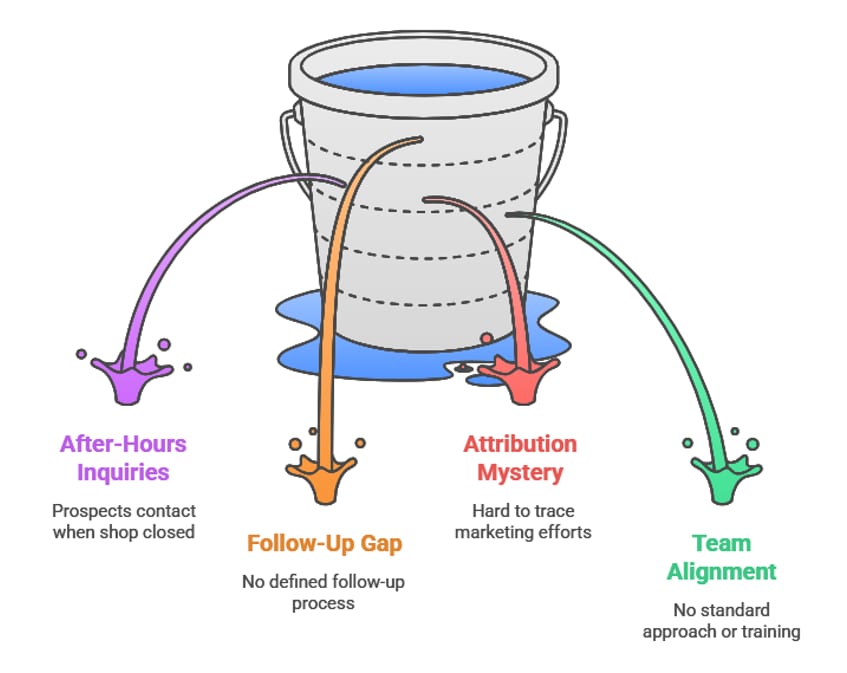
Image provided by Anthony Milia using AI.
The Hidden Opportunity Areas
Through shop tours and strategy sessions this year, I have noticed common areas where even successful fabricators find room for improvement:
- The After-Hours Inquiries: High-intent prospects reaching out when the shop is closed. Often 15-20% of total inquiries. Systems to capture these can be game-changing.
- The Follow-Up Gap: Lead comes in, initial contact happens, but systematic follow-up does not. Not because of poor intent, but because there is no defined process.
- The Attribution Mystery: Marketing generates activity, but it is hard to trace which specific efforts led to closed jobs. It makes it difficult to invest confidently. Implementing better technology and a better CRM can help with this.
- The Team Alignment: Everyone knows they should capture contact information and schedule appointments, but there is no standard approach or training. None of these are failures – they are simply opportunities that become visible when you look for them.
What the Best Performers Track
The shops I have seen make the biggest leaps this year share a common approach: they know their numbers. Not obsessively. Not perfectly. But they have visibility into:
- Which marketing channels bring in qualified leads
- What percentage of inquiries turn into appointments
- How appointments convert to quotes
- Which lead sources close at the highest rates
This is not about having expensive software or complex systems. It is about consistent measurement of what matters.
Reflection Questions for 2026 Planning
As you think about next year's goals, consider these questions:
On Lead Management:
- What happens to leads that come in after hours?
- How quickly does your team typically respond to new inquiries?
- Do you have visibility into which inquiries convert and which do not?
On Customer Experience:
- What does a great first interaction look like for your team?
- When was the last time you experienced your own sales process as a customer would?
- Does your team have clarity on the customer journey?
On Systems and Data:
- Can you easily track a lead from first contact to completed job?
- Do you have the data you need to make confident sales and marketing decisions?
- Are there areas where you are operating on assumptions rather than information?
These are not "gotcha" questions – they are simply areas where increased visibility typically reveals opportunities.
The 2026 Opportunity
Here is what excites me about the year ahead: the shops that have been building their foundation are about to see it pay off. If you have invested in better systems, team training or marketing measurement in 2025, you are positioned for strong growth. The groundwork has been laid. Now it compounds.
And if you are realizing there are areas where you would like more visibility? That is not a problem – it is valuable awareness. The shops that will struggle in 2026 are the ones who keep operating on assumptions without ever seeking clarity.
Where to Start
If you want to approach 2026 with more confidence, here is a simple starting point:
Review your last 30 days of customer inquiries. Whether that is calls, form submissions or emails. Look for patterns:
- Which sources brought the highest-quality leads?
- Where did strong prospects not convert?
- What questions came up repeatedly?
- Where did the process feel smooth versus clunky?
You will likely spot two to three areas where small improvements could yield significant results.
The beauty of this reflection? It does not require a massive investment or complete overhaul. It just requires honest assessment and a willingness to optimize.
Building on What's Working
The fabricators and showrooms thriving in 2025 did not reinvent everything. They identified what was already working and built on it. They found small gaps and closed them systematically. They invested in visibility so they could make informed decisions.
That same approach will separate the winners from the rest in 2026. You have built something in 2025 -- whether that is systems, marketing momentum or customer relationships. The question is not whether it is perfect. It is whether you understand it well enough to optimize it.
As you plan for 2026, give yourself the gift of clarity. Know what is working. Understand where the opportunities are. Build on the foundation you have created.
The shops that will dominate next year are the ones approaching it with eyes wide open.
SHARE THIS
Rod Sigman CTC, CCTS, CSMTT is the business development leader for MAPEI Corporation’s UltraCare® line of products for the care and maintenance of tile and stone products. Sigman has a proven track-record of success in the flooring industry, with experience in both training and education, as well as all support functions pertaining to national sales accounts and distribution. He has served on the technical committees of the National Tile Contractors Association (NTCA) and the Natural Stone Institute (NSI). He has successfully completed the Ceramic Tile Consultant Course, is a Certified Ceramic Tile Specialist (CCTS) and is also a Concrete Slab Moisture Testing (CSMT) Technician. Further, he was recognized by the Marble Institute of America (now the Natural Stone Institute) as a significant influence for the stone industry.
next article